The above image serves as a pictorial representation of Bush's final days in office, as he prepares to leave office with a higher disapproval rating than any recent President, including Nixon.
Even though President Bush is STILL the President for another 7 weeks or so there recently has been a proliferation of retrospectives. Or, colloquially, Americans are asking, "How the hell did we get into this mess?"
Evidently, the Bush Administration is revising its own history, as it were. As the clock winds down, what can be said for the past? Quite a bit, but it depends on who's saying it, and for what purpose.
ETA: The first thing that pops up for the Google suggested searches when you type in "President" with a space at the end is "President Obama." America is looking forward.
I had heard of it, but never really put much thought into it. This morning, I decided to explore the Twitter webpage and found it rather...cryptic. The Welcome page has this to say:
Twitter is a service for friends, family, and co–workers to communicate and stay connected through the exchange of quick, frequent answers to one simple question: What are you doing?
What am I doing? Well, currently I'm reading the Twitter page, but beyond that I have to wonder why anyone would care. My first reaction was that Twitter encapsulates the faux closeness that the internet provides, but then I got to thinking. What is the purpose of Twitter? 140 characters isn't long, so brief updates are the norm. Anything from, "I feel sick" to "I watched FoxNews for 6 hours and learned a lot about Obama's new economic team." Rather than closeness, Twitter acts as a platform for conversations that could be held outside of the Twitter forum. Much like a blog post lends itself to comments, Twitter starts conversations and allows people to glean information about someone else's life through conversational snippets.
The media cloud of blogs, comments on stories, and instant information gives a voice to those who may have felt disenfranchised by popular media. Twitter could possibly act as a conduit for those who like to stay instantly connected.
Conversely, Twitter reminded me of something that happened just the other day. My friend and I were Googling our names and the first thing that popped up for me was MY Facebook page. Caroline Mooney, Hartford CT. There I was. It made me feel like I was on the Truman Show, which, evidently, is a contemporary phenomenon fueled by Facebook newsfeeds and Google searches.
So, how will the media react to sites like Twitter if their popularity continues to grow, or even grows exponentially? What will the internet look like in 2012? Twitter, much like the Barack Obama text messages allows anyone you "follow" to immediately tell you whatever they think is important. If the Obama administration, MSNBC, FoxNews, or another person, governmental body, or media outlet got a Twitter page, much like the Obama Facebook page, it would allow them to enter your home and your daily life as seamlessly as a new friend does. The result is one we've talked about often in regards to blogs: short bits of information that feed into how the Google Generation looks for news. Maybe some would take the time to research the story, but imagine if FoxNews twittered (is that a verb?) headlines their followers:
"Obama's pastor gives vitriolic anti-American sermon."
"Obama's secret ties to Kenyan government."
"Obama uses cabinet appointments to further his liberal agenda."
Perhaps I'm paranoid, but I don't want anyone to know what I'm doing all the time, nor do I want to know what anyone else is doing all the time, nor every headline that comes across as a news alert. News organizations could certainly utilize Twitter to their great advantage. It seems like an interesting tool. And now, after Obama and McCain's webpage face-off, the internet will probably become an important tool to potentially reach the ever-apathetic youth voter. Maybe sites like Twitter will win the next election for whomever is savvy enough to get in on the ground floor.
The Obama cabinet is shaping up to be more centrist than some on the right thought. There were fears that Obama would choose only exceedingly liberal politicians to help him govern, but those fears have been assuaged with he announcement of Obama's economic team. But, how can members of the conservative media tell the story without giving Obama credit for using the cabinet to balance out Republican and Democratic viewpoints? Ah! Claim that the left has "buyer's remorse" and that the far left is angered by these centrists because they "don't think exactly as we do!"
Now, contrast the above story to this one from the New York Times. Instead of complaining about "liberal feelings" with no evidence, the Times states the choices reasonably and in a way that engages the reader. The article lends itself to discussion, rather than a screaming match.
Just for a further comparison, I found this gem of an article from NewsBusters on the same bit of video and the same story. For kicks, read the comments at the bottom. This is my personal favorite:
Let's have a full accounting of coke-head Obama's life. Still don't know anything about him.
College records. Where are they? Why won't he release them and his thesis?
State Senate records. Where are they?
Medical records. Are you hiding some physical or mental defect? Doesn't the country have a right to know?
Passport. Why don't you want people to see where you have been? Wouldn't that go a long way to bolster you're Foreign Affairs experiance?
Application to Illionois Bar. Did you mention your drug use on it? Or are you trying to cover up that you did not fully disclose everything about you.
Riddled with spelling errors and bizarre assumptions, posts like this make me realize that the internet gives everyone, regardless of ANYTHING except access to a computer, the right to be heard by anonymous millions.
It struck me that a greater proportion of conservative blogs have the same air of paranoia about Obama, his history, his religion, and even his (presumed) cabinet appointment. Very few of these issues are looked at objectively and often positions are given without supporting evidence. When was the last time you saw a conservative blog engage in lively, spirited debate with the other side? (Note: debate in this case means a reasoned argument supported by evidence, not talking over the opponent.)
Could it come from years of conservative talk radio, which is full of personalities like this?
His eyes, which off-air are usually flat and unhappy, are alight now with passionate conviction.[...] As is SOP in political talk radio, the emotions most readily accessed are anger, outrage, indignation, fear, despair, disgust, contempt, and a certain kind of apocalyptic glee, all of which the Nick Berg thing's got in spades. [who is in turn able]to enjoy the authority and influence of journalism without the stodgy constraints of fairness, objectivity, and responsibility that make trying to tell the truth such a drag for everyone involved.
However, as with every generalization, there are exceptions to the rule. Take, for example, this fantastic article by Byron York from the DC Examiner. One of the most interesting byproducts of this phenomenon is that now seemingly everything is both fair gain and news. Michelle Maklin is a big proponent of this sort of news
Did Obama buy the vote? Uninformed Obama voters? You bet!
There are uninformed voters everywhere. Single issue voters, clever editing, whatever you want to call it, this little video makes me think of a Jay Walking segment.
No, seriously. Lisa Miller from Newsweek interviewed people for whom this is an actual possibility.
This is one of the most puzzling articles I've ever seen from a publication as reputable as Newsweek. I understand that newspapers and magazines should stock their pages with all the news that's fit to print, but this just seems incendiary and a bit strange. For people religious enough to believe in a physical Antichrist, the article reaffirms their points, and for those who think that's a bit (or exceedingly) wacky, it comes off as entirely too serious. I would have like to read an article that outlined how Millennialist or Evangelical Christians feel about Obama's win. However, Miller didn't write with that sort of finesse. For example,
The people who believe Obama is the Antichrist are perhaps jumping to conclusions, but they're not nuts: "They are expressing a concern and a fear that is widely shared," Staver says.
They're not nuts? Well, "nuts" is a little strong, but couldn't Miller have written that entire thought in the voice of Staver? Her article strikes me as rather tactless but I can't tell if my reading of the article is marred because of the horrible title.
Certianly, the Rapture has been big business lately. With the advent (get it?) and popularity of books that discuss Evangelical themes, such as the Left Behind series, more and more Americans are discussing Rapturous happenings unabashedly, and, more importantly unironically.
Evidently, the authors of the Left Behind series do not think that Obama is the Antichrist, so that's one point for sanity.
ETA: Whenever I hear about the Apocalypse, I always think of Durer.
I think this fits in nicely with out discussion of those whom we lovingly labeled "scary, crazy people." It's one thing for racists to burn crosses under cover of darkness and sheet, but it's another to purchase a product that lets everyone who drives by your house know that you subscribe to this set of values. I'm not sure if an Obama Presidency will increase the number of racist attacks or tirades. But, sequestered in Connecticut, I don't think I'll be able to tell unless the MSM lets me know that something is awry.
A blogger got a screen capture of the entire listing here.
Barack Obama has been considering Hillary Clinton as Secretary of State, but how much of a liability is the Clinton Foundation? Former President Clinton has been "reluctant to disclose the donors," according to Philip Rucker of the Washington Post. Rucker goes on to say,
"It's a little bit unclear what happened there, but there are some reports that he's helped -- that Bill Clinton helped facilitate a deal there in uranium in Kazakhstan, and in turn, there was a donation to the foundation."
The possible offer of a cabinet position for Hillary Clinton is certainly an interesting one, and one that I am having trouble with for two reasons, in addition to Bill's charity posing a conflict of interest.
1) Hillary Clinton has a big personality is very ambitious. There's no way that Clinton would like being subordinate to Obama and, if anything were to go wrong in the Obama administration, she would be jumping off the ship as fast as possible to preserve a future bid for the White House. I think that it would behoove Senator Clinton to stay in the Senate and push for Universal Healthcare and Pre-K, and other programs she was touting during the primaries. Rushing off from her Senate seat might seem disingenuous and give creedance to those carpetbagging allegations launched against her a few years back. She has plenty of time to season and mature as a politician, and, with more experience, could be an excellent President. She's in a position to run for President in 8 years with more experience than many other female candidates (ex: Sarah Palin) and the blessing of name recognition.
2) Bill Clinton hasn't seemed as calm, cool, and collected as usual for the last few years and, both during and after the campaign, he was rather unfair to Obama. The Clinton's played dirty pool during the campaign. They (presumably they were behind those "anonymous" leaks) lobbed every single allegation that they could against President Elect Obama, but Hillary still lost, perhaps due to disorganization within her own campaign. Plus, if Senator Clinton did take the Cabinet position, Bill Clinton's personal relationships with world leaders, if not his charity, could pose a conflict of interest. There's no way to know what Bill Clinton has said to some of the most powerful people in the world, whom he counts as friends. Barack Obama's presidency is not the Clinton Administration Part III. Obama will have his own agenda and this could cause points of contention between Bill's dealings and the official stance from the administration.
Hillary and Bill Clinton still seem surprised by Hillary's loss to Obama, and, not only are they not over it, I would bet that they're planning a run in 2016, if not sooner.
As I type, Wolf Blitzer has a feature entitled Senator Clinton as Secretary of State and Where Sarah Palin Goes From Here. These are interesting issues, but the most interesting part is who he has on the program. Both Hilary Rosen from the Huffington Post and Terry Jeffery from cnsnews.com are on and talking about the future of both parties and what spaces, if any, are open for women. Wolf Blitzer shows his (and cable news') relevance with these two representatives from widely-known internet news outlets.
As the Era of Obama dawns, will there be continued collaboration between internet, print, and television news sources? There's no way to tell for sure, but it'll be interesting to look out for.
This post stemmed from an article that came from Harry's Blog.
This is a fascinating snippet from the article:
CBS's underlying problem -- and the commonality between the three items that I described above -- is the arbitrary and largely ineffectual nature of the fact-checking process employed by the mainstream media. I have written for perhaps a dozen major publications over the span of my career, and the one with the most thorough fact-checking process is by some margin Sports Illustrated. Although this is an indication of the respect with which SI accords its brand, it does not speak so well of the mainstream political media that you are more likely to see an unverified claim repeated on the evening news than you are to see in the pages of your favorite sports periodical.
Sports Illustrated deals with concrete versions of the facts. Sports are numbers. How many points did Michael Jordan score in 1993? Well, there's a number out there somewhere. One number. It's not a contested story. And, if Sports Illustrated got this number wrong, a sports statistician would know. He could point to all of the examples of Michael Jordan scoring a point, and thus SI would probably print a retraction and everyone would move on.
However, when we move on to the more nebulous realm of the MSM, when it comes down to "facts," what are we discussing? Versions of the truth? Whose version? I think these questions are at the heart of all the other questions we've discussed this year, from bias to comedy to race. Take this picture of Kim Jong Il, for example. It looks like he's really there at first glance doesn't it? He couldn't be dead. Surely not. There's photographic evidence that he is standing of his own power with his troops. But is he really?
Perhaps in a lot of ways, the MSM is, in some ways, duping the public, like Kim Jong Il's regime. Not to that extent, mind you, I'm not calling the MSM a fascist regime, but most people in America trust the MSM and don't believe that a) the media would lie, or b) the media could lie.
The media won't lie outright; the public would find out, I imagine. But, consequently, how do biases, the need for ratings, and liberal or conservative apeasement change the credibility of stories? Do people question what they hear or just repeat it without judgement or their own filter?
Look closer at the above photograph.
Discrepancies abound, but how many people who are under Kim Jong Il's (possibly dead) thumb would even know that such as thing as Photoshop exists? Editing pictures? Editing the photographic evidence - editing the facts. It sounds like science fiction. No one would inspect a photograph this closely if they didn't know that editing photographs was possible.
Take this picture and the 538 story as an example of a larger phenomenon. Sometimes the media isn't lying, they're stretching the truth, maybe, but they do it for a purpose. Don't forget that sometimes, what CNN, MSNBC, or FoxNews wants is ratings. They're not non-profits. Your attention equals money in their pockets, and sometimes that attention has to be manufactured.
As much as Democrats see an Obama presidency as the beginning of something new and exciting, many Republicans are nervous. Perhaps this fear is being increased by FoxNews (the video is a bit campy, but it makes a good point):
Look at the dates on the video. Attacks on Obama from the right and the left started in early 2007, when several Democrats had announced their intent to run for President. Why wasn't FoxNews attacking John Edwards or even Chris Dodd? Could it be, perhaps, that Barack Obama was (and is) a frightening figure because he's African American? The only other Democrat who got a fraction of this treatment was Hillary Clinton, who had the double whammy of being female and a member of the Clinton Democratic dynasty.
From these incendiary beginnings, the election proved that not all Americans can be brainwashed by scare tactics. However, now that Obama is American's new President-Elect, both sides are crying persecution. Take these examples into consideration:
1) A middle schooler who wore a teeshirt to school that said "McCain Girl" chronicled her peers reactions. From the article,
People were upset. But they started saying things, calling me very stupid, telling me my shirt was stupid and I shouldn't be wearing it," Catherine said.
Then it got worse.
"One person told me to go die. It was a lot of dying. A lot of comments about how I should be killed," Catherine said, of the tolerance in Oak Park.
Kudos to Catherine for being inquisitive, but there are several things wrong with this story and the way that the article was written. First of all, middle school has never been known as a paragon of tolerance. Most people try to get out of middle school with the least amount of mental anguish possible, and oftentimes that includes making fun of the kids who are different so the crowd doesn't turn on you. For the reporter to write this article as if these 12-14 year olds who are both full of hormones and unable to vote is irresponsible and incendiary. Oak Park is a very liberal suburb of Chicago, Obama's hometown. Most (or all) of the children who made fun of Catherine got their political ideas (probably just Obama good, McCain bad) from their parents anyway. Add to that the hometown pride phenomenon and you're solidly in Obama territory.
With that said, I don't know if I can point to any person I know who didn't get made fun of in middle school, whether for clothing choices, hairstyles, or even just physical appearance. To make a case for "liberal intolerance" with a group of middle schoolers as the sample is just bizarre and sloppy journalism.
2) An Ausberg College student who was, allegedly, beaten up by four, larger black women who called her a racist for supporting McCain/Palin. From the article,
The team trainer, who checked her out the next day, said she probably had a concussion and barred her from practice for two days. She said she's also been required by the school to attend counseling and missed a day of classes. [...]
Augsburg spokesman Jeff Shelman said the school doubts that the women are students, citing a review of dorm building video surveillance that evening and the fact that the victim didn't recognize any of them.
So after this vicious attack, the alleged victim does not get checked out by a doctor, nor call the police. Instead she waits until the next day to get checked out by her hockey team's trainer. Not only that, but no such women (or attack) are seen by the other students present or the school's surveillance cameras. Is it possible that this girl could have gotten injured another way and made up a story overnight to show the depths of liberal intolerance? It's been done before.
Shouldn't the separation between church and state go both ways? What about helping the poor and other corporal works of mercy? Why should the church only care about abortion, which is legal anyway and doesn't appear to be going anywhere? And, if the sanctity of life is what's crucial, how could such an organization support Republican candidates who are in favor of the death penalty?
When did religion get tied to the right so intimately and doesn't it weaken the church's tax-exempt status if the priest is using his pulpit for politics?
The article also addresses the Democratic Catholics who have been disenfranchised by statements like this:
"Father Newman is off base," said Steve Krueger, national director of Catholic Democrats. "He is acting beyond the authority of a parish priest to say what he did. ... Unfortunately, he is doing so in a manner that will be of great cost to those parishioners who did vote for Sens. Obama and Biden. There will be a spiritual cost to them for his words."
If nothing else, Obama and McCain supporters can agree on the fact that this is one of the most divisive elections in recent memory. Both sides have been unfairly treated by a select few and the media is covering it, not just for the story, but, perhaps, also to show how unfairly their side is being treated. There's a difference between reporting stories in a factual and unpolitical way that doesn't push the two sides further apart.
How do moderates feel because of all this? When the entire American political system has been deeply cleaved into "RIGHT" and "LEFT" how are people supposed to make up their own minds instead of buying into reports of intolerance, from either end?
I've noticed that this Hillary Clinton ad from last year has been contrasted with the Obama ad below lately.
Notice how Hillary is all alone in her ad, wrapping presents with Bill nowhere in sight. She's her own woman and a generous one, you see. Barack Obama, on the other hand, is sitting with his family, looking cozy and warm without an overly strong political message.
There was a snippet about these two ads just the other day on CNN. The anchors discussed how the two ads followed the campaign patterns closely, right down to Obama being more about image than substance. It's an interesting microcosm of the politics we've seen over the last year or so.
As one can see from this 2007 CNN video, I guess it's something to look forward too with Obama as our President Elect.
P.S. Don't forget that it's up to Mike Huckabee to remind voters (and the religious right) about the true meaning of Christmas!
Now that the campaign is over and a winner has been declared all of that off-the-record good stuff can come out. But, McCain/Palin won't go down without a fight. We've seen Sarah's bizarre airport interview, GOP lawyers flying to Alaska to retrieve Palin's clothes (at a cost that is surely higher than the clothes are worth), and even numerous interviews with McCain and Palin expressly asking, "What went wrong?" as if the two of them would be able to cite exactly what it was, or even tell the truth if they could.
Interestingly, this article from the Daily Kos breaks down exactly what happened in the campaign (and what was eventually, in my opinion, McCain's downfall) months before the events occurred. Unless the writer was blessed with the gift of prophecy, it was clear to many political commentators that, because of McCain's choice of political and campaign advisers, he would run a dirty campaign, much like the one Bush ran against him in 2000. Politics is crawling with sore losers. It's rumored that Bush II ran because Bush I didn't get his second term. Hillary Clinton has been keeping her 2012 (or 2016) hopes very much alive, and Sarah Palin has been doing the same. John McCain tried to run on that "sore loser, just attack until there's no one looking at your politics" platform, and thankfully, it didn't work. This time.
There's been a lot of talk lately about the "New Head" of the Republican party. But, when was the last time that the Republicans had a notable, respected leader?
Remember the primary race? John McCain was a face in a sea of thousands for those many months. Rudy Giuliani, Mitt Romney, Mike Huckabee: An adulter, a mormon, a Southern Baptist minister. Though this sounds like the beginning to a very bad joke, these short descriptors highlight the fact that these are three very different men who would have taken the party in three very different directions. The people chose John McCain, but not by a comfortable margin.
Perhaps this is due to the fact that the Repubican party doesn't know where it's going. John McCain used to be seen as a moderate and progressive senator. However, he wasn't conservative enough for the new base of religious zealots, and, with his flip flopping on the issues and his choice of Palin, he wasn't moderate enough for the moderates. For now, I think it's impossible for the entire Republican party to find a leader who is able to dance between religious nuttery and reasoned social and fiscal conservatism. If there's no middle ground, how can there be a consensus? How can a party rally around a leader if they don't know which side they're truly on?
I hate to come back to old Ronnie, but he's the last important, formative Republican head of the party that I can remember. He won two elections, the first of which was against an incumbent. At the time, there wasn't the same Republican pandering to the extremely religious right. Are the Republicans going to have to cut ties with this "base" and move on?
As I've said before, there's a deep rift between the two major factions of Republicanism. Sarah Palin on one side and Olympia Snow on the other. Before Republicans can find a "head" they need an identity.
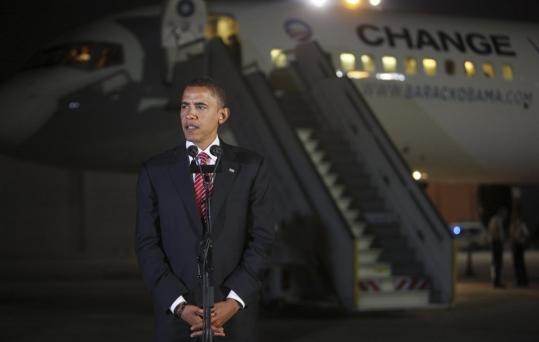
I conceptually understand the Republican argument about Barack Obama's "Cult of Personality," but honestly, isn't that what a President is? Think of the archetypal president: calm, cool, patriotic, level-headed, charismatic, witty, engaging, and stylish. Do Americans want a true maverick? Do Americans want a cowboy? Maybe some do, but bucking the Presidential image hasn't been successful. Take a look at this picture and tell me that you wouldn't be proud to have this man step off the tarmac and represent you, an American.
There's a certain swagger or "coolness" as well as an unmatched intellectual prowess and fairness that Americans demand from public figures, whether they realize it or not. The archetypal American President is a combination of George Washington and James Bond. Bush didn't have that personality. His appeal was maintained by only a small subset of America.
But why? When Bush was elected, Americans were quoted saying that they could see themselves having a beer with him. A beer? How about a serious political discussion? Not so much. He appealed to the common man, but in a time of crisis do you want the common man leading the country? According to approval rating polls, evidently not. Perhaps, President Bush's personality said one thing to America in 2000 (cowboy), and another thing after Hurricanes Katrina and Rita (incompetent boob).
Beyond personality, did you ever see President Bush or Dick Cheney (or anyone from the administration) looking this comfortable and naturally happy in a public setting?
Think of Ronald Regan. Many Republicans cite him as one of the best and most charismatic Presidents. Look at his background: Regan was an actor and a fantastic orator. His policies weren't the best that the world had seen, but in many ways he gave off the aura of a President with his innate abilities - his personality was presidential.
One last point: take a look at this chart of the physical characteristics of Presidents (and presidential candidates) from the New York Times. Could they have made the John McCain silhouette look punier and less presidential?
As icing on the cake, Obama even manages to look more like a movie-star cowboy than George Bush.
In response to this article, I present this puzzling photograph that was sent to me a few months ago:
Note the Confederate Battle Flag and the Obama sign. Racism in the America (and especially the South) is a complicated issue, as is the display of the Stars and Bars. To some, the Confederate Flag shows that blatant racism is alive and well in America. To others, it represents a heritage or acts as a symbol of fallen family members and a shared past.
American history is a complicated and messy thing. Now, on the heels of the Obama election, what will happen? I'm not wondering if Obama can unite our vast and diverse country, but if such a thing is even possible.
Or, have people been letting the vocal minority shout over the reasoned majority? Perhaps, to most who feel an affinity towards the Confederate flag, it acts as a symbol of heritage, not the symbol of our corrupted past. Can those who proudly wave the Confederate flag also be Obama supporters? Evidently, yes. And that makes me a little more proud of my country.
Along side the anti-Obama crowd, there are right wingers in the media who claim that Bush's presidency was "unlucky," that he was "unfairly treated by the left," and that all of "the disasters he faced were not his fault."
Jeffery Scott Shapiro, an Op-Ed columnist for the WSJ, has this to say:
Those bipartisan efforts have been met with crushing resistance from both political parties.
The president's original Supreme Court choice of Harriet Miers alarmed Republicans, while his final nomination of Samuel Alito angered Democrats. His solutions to reform the immigration system alienated traditional conservatives, while his refusal to retreat in Iraq has enraged liberals who have unrealistic expectations about the challenges we face there.
I'm not one to throw around the word "apologist," but in all honesty, even a reasoned, well-written piece about how Bush has been unfairly treated just makes Bush's time in office sound like a failure. There are compromises in which both parties feel represented and compromises in which both parties feel like losers. President Bush's time in office has been marred with countless instances of the latter. Trying to help both sides and failing miserably doesn't speak of an "unlucky" term. After 9/11, his approval ratings were hovering around 90%. America looked up to their President and expected great things from him. But what about Hurricane Katrina, the war(s) in Afghanistan and Iraq, the rapidly growing National Debt, the current financial crisis, unconstitutional wire tapping? The test of a President is how well he can handle himself and make decisions during a crisis. Bush didn't fail in these situations because of the left wing media; he failed because he didn't know what to do and had people around him who couldn't help.
 The above image serves as a pictorial representation of Bush's final days in office, as he prepares to leave office with a higher disapproval rating than any recent President, including Nixon.